After having used mobile or semi-fix installation for more than 2 decades, I was lucky enough to get installed in a place with a garden sufficiently large to welcome a home-made backyard observatory. In the first two years I could use successfully a Mewlon 250 in the context of double-stars measurements. It was not uncommon to separate couples with rho as small as 0.4 or 0.5 arcsec. This conclusion led me to consider a larger installation which would fit the following list of requirements which I considered of first importance.
Let us discuss this different points in more detail and how they impact the choice of the instrument.
The high resolution criterion in my case means significantly larger than the 250mm of the Mewlon previously owned. I considered 350mm as the lower bound. After many thinking, a diameter of 400mm seemed a good compromise between 350mm and 500mm which I considered as the upper bound my finance could perhaps afford. This immediately removes the possibility of using a refractor. Such big ones exist in amateur world but they are the exception, fully home made, and require gigantic installation (mount, shed,...) which I do not consider. The solution of the Schmidt-Cassegrain design is also rejected, although commercial solution exist (for instance Meade 16" SC), but with little confidence on the optics quality and mechanical stability. The showstopper for SC is the unability to perform in UV (and to some extent in blue), because of its inherent spherochromatism. UV wavelength range is used especially for some planetary observations, in particular Venus.
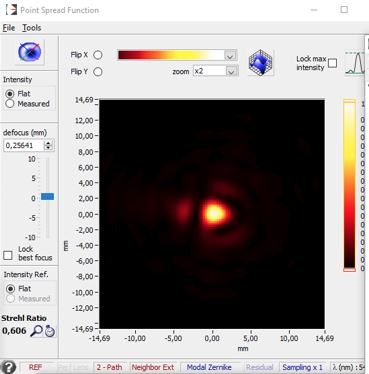
This type of observation relies almost completely on the ability to reach both stars Airy figure. A particularly complicated situation happens when the faintest component is positioned in the first ring of the brightest one. There the obstruction plays a significant role, affecting directly the Strehl ratio. It is not by coincidence if big old historical refractors are still doing a very good job at this type of observations. In the figures here below we have the theoretical result of a 0.4 arcsec doublet, with magnitude difference of 8, and four different obstructions: 0%, 20%, 30% and 40% [Aberrator].




While obviously the resolution if not directly impacted since it depends only on the wavelength and aperture diameter, the contrast degrades strongly with the obstruction at particular spatial frequencies. I have defined my acceptable upper bound as being 25%, knowing that 30% still allows excellent performances.
These two requirement fix therefore the diameter to 400mm and the obstruction to smaller or equal to ~0.25.
[Aberrator]: http://aberrator.astronomy.net/
I practice low resolution spectroscopy with an ALPY 600 (Shelyak). It performs best with an F/D around 5. Besides, deep-sky imagery, and in particular the imagery based on short exposure (possible with low RON CMOS) requires F/D below 5, typically. The main conclusion from these two points is the need to access a F/D that may be go down to 3.5 or 4.
This rules out optical designs such as pure Dall-Kirkham, Gregory or Cassegrain: the obstruction at such F/D would be very large and other effects such as field curvature, coma, astigmatism,... would become too large.
The only design which fulfills the four requirement given above is based on a Newton design. This means, a "simple" newtonian, or newton-cassegrain or newton-gregory,etc... The last point to determine is the best F/D ratio of the primary mirror. The spectroscopy and deep-sky imaging points indicate a ratio between 3.5 and 5. The exact choice is a quite tricky point, since it impacts several things. Here are some first-order examples:
A F/D ratio smaller than ~4 is incompatible with a small obstruction AND a field of full illumination larger than 20mm (partially due to the constraints on tube dimensions). After long debates I finally chose 5 for the primary mirror F/D. It is still possible to reach F/D below 4 using a good reducer if the sensor is not too large (<20mm diag), and using a Wynne corrector, large sensor such as KAF 16803 or IMX455 can be used with fully corrected field.
Here are a summary of the optical properties of this optical choice.
Defining L the light wavelength and D the diameter, both in millimeter, the resolution of this instrument can be expressed as either 1.22*L/D in the sense of Rayleigh or ~1.02*L/D in the sense of Dawes, which yield 0.34 and ~0.29 arcsec respectively at L=550nm.
The light gathering compared to a 6mm eye pupil is deduced from the primary mirror surface minus a secondary mirror obstruction of ~25%, which yield a total collective surface equivalent to a main mirror with D=386mm . It yields a gathering factor of ~3800 (assuming two reflective surface with 96% reflective power each) which in magnitude translates into a bit less than 9.
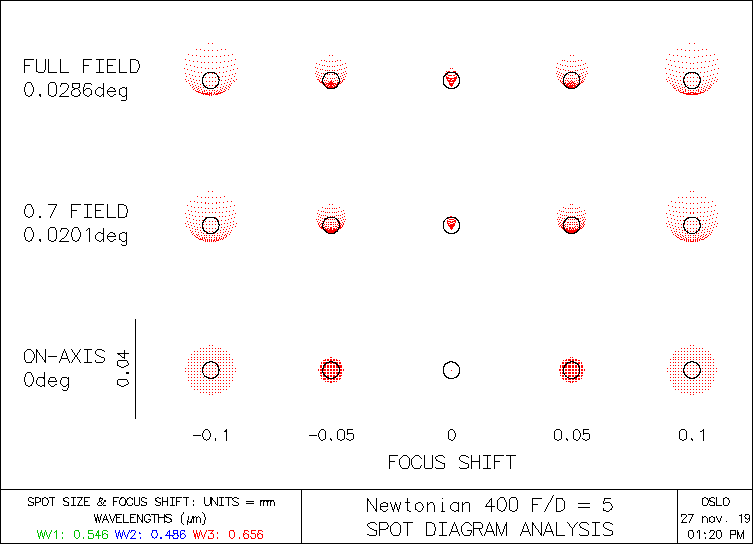
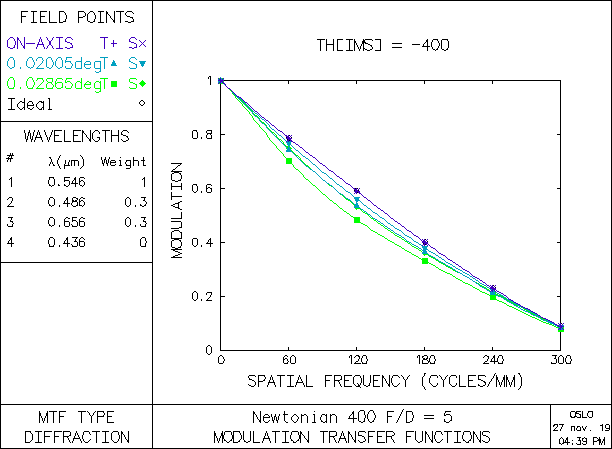
This radius is defined by the region where the sum of aberration (coma, astigmatism,...) do not alter in a significant way the wavefront. It is close to 38F^2/D^3, expressed in arcmin, where F is the focal length and D the diameter of the aperture [CV,TO]. In our case this means 2.7 arc min, essentially limited by the coma resulting of using a using parabolic primary mirror. This limit also corresponds to a decrease of the Strehl ratio below 0.8.
[CV]: http://www.astrosurf.com/viladrich/astro/instrument/sensitivity/sensitivity-analysis-Newton.htm
[TO]: https://www.telescope-optics.net/newtonian_off_axis_aberrations.htm
While the commercial offer of SC, cassegrain, (C)DK, RC , refractors is large, there are not so many manufacturers proposing 400mm newtonians at F/D=5. The reason? Not sure but the size of that beast may be quite discouraging. Maybe also because this design is not comfortable for visual use in comparison with catadioptric designs that have the light exit behind the tube. These are probably the only less charming points of the newtonian design. For the rest: the optics are not exotic so with the same effort the optician may reach a better level of polishing, the light crosses the tube only twice which reduces the possible effect of inner turbulence compared to the catadioptic ones for which the light crosses it three times.
Since I do not have the skills and time to build things in aluminium, carbon, neither to polish optics, I had to find people or companies would could help me on this. After months of thinking and discussions I went for to the following choices:
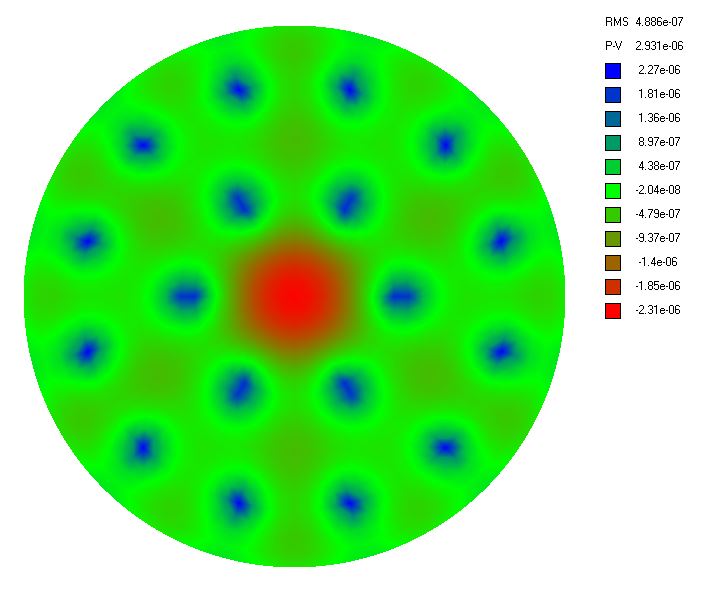
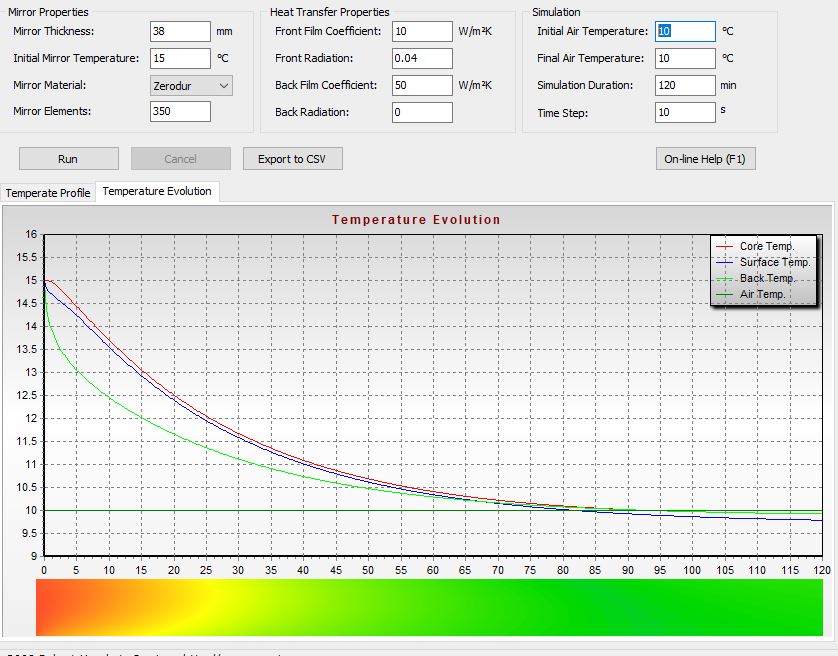
Now it is clear that a full tube is more sensitive to wind, but I do not plan to do high resolution imagery by windy conditions. Besides, a full tube is more tricky to get at the good temperature internally. The way to get rid of this problem to get mirrors which are not too tick, and install an active thermal regulation (fans) for the primary one. Here below is a rough estimate on how fast a mirror with active cooling from behind (fans) can be set at temperature. Considering that a deltaT of 1 degrees starts to be acceptable (we assume here a sufficiently large tube so that hot air currents exit from the tube without affecting significantly the wavefront), the time is here estimate to 40 min, assuming 5degrees difference between the air and mirror initial temperature. This estimation is performed with MirrorCooling freeware [MC]
[PLOP]:https://www.davidlewistoronto.com/plop/
[MC]: http://www.cruxis.com/scope/mirrorcooling.htm
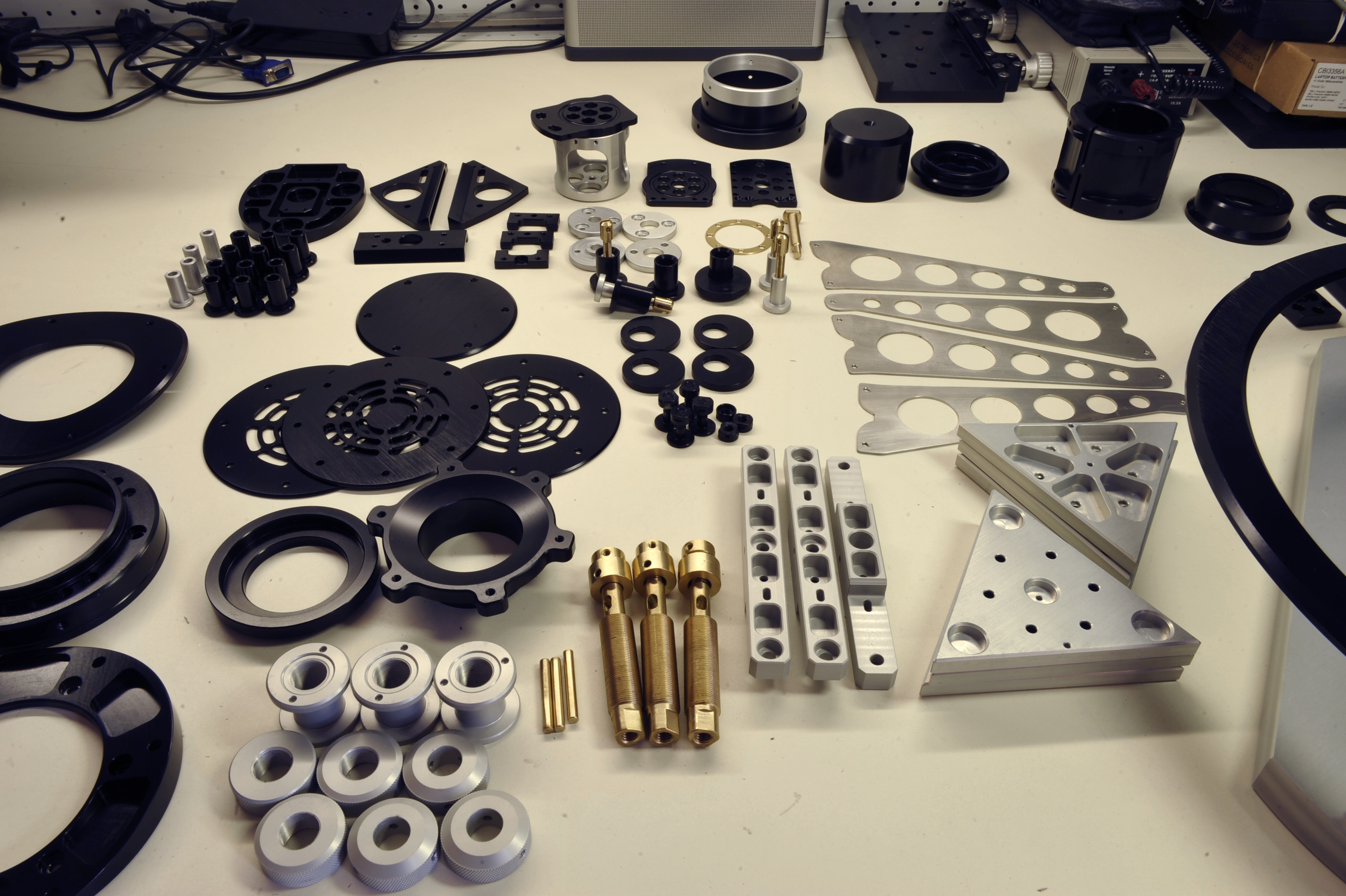
Set of mechanical pieces required...quite a nice jigsaw :-)
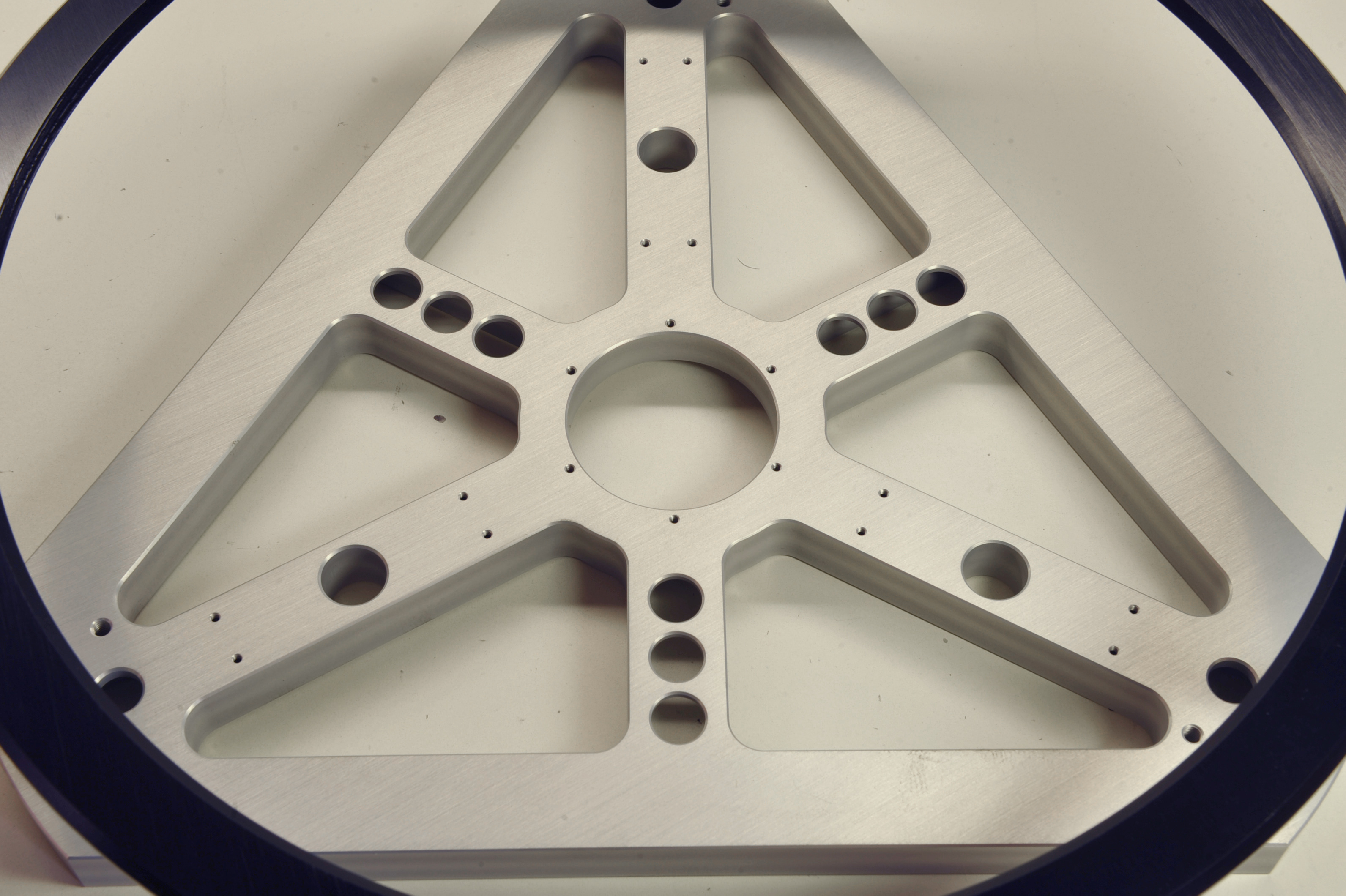
Close from from the primary cell
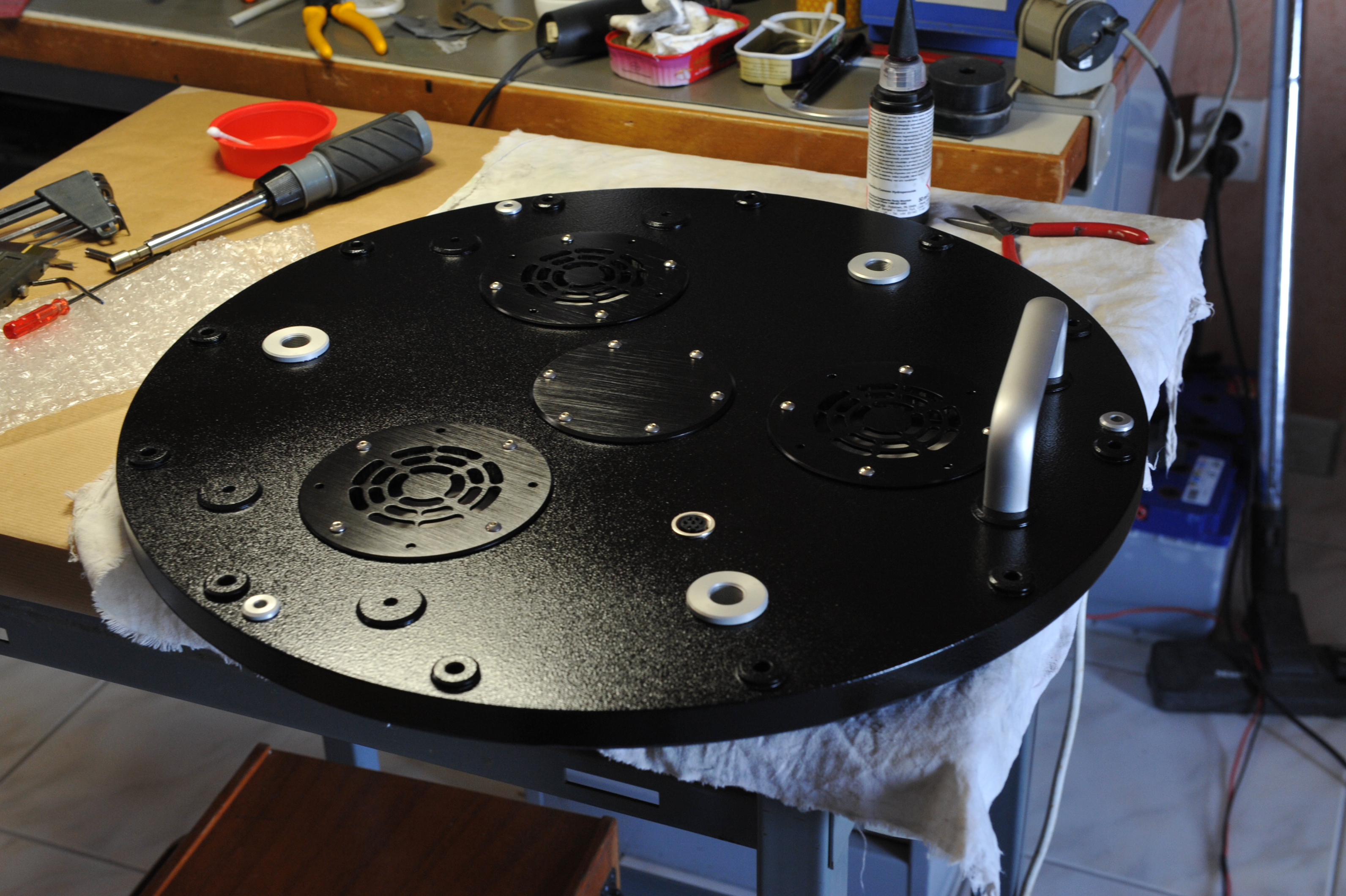
The rear cap with the fans protection installed. The cap is a carbon-nida composite. The white rings indicate where the primary mirror adjustment poles will emerge from the cap.
Back to homepage